What Makes a Rental Yield "Good" in Mumbai?
The average yield for residential property in the city ranges from 2-5% depending on location, building type and developer. Above 4% in the suburbs is good. 5% and above is great.
But a percentage is not the only consideration. Other areas have a lower percentage yield, but little vacancy. Others offer high percentage yields, but with high maintenance fees or weak tenant demand. You want to find areas with both income and occupancy.
Which Are the Top Areas for Rental Yield in Mumbai?
1. Why Is Navi Mumbai a Top Choice for Rental Yield?
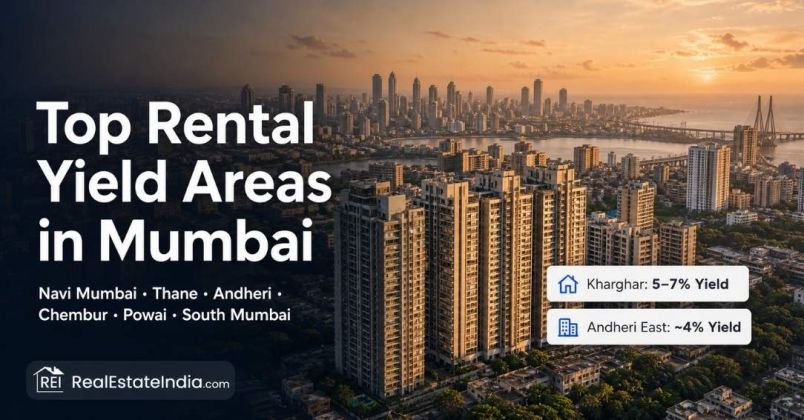
For yield seekers, it's all about Navi Mumbai. Yields of 5% to 7% are consistently achieved in Kharghar and Panvel, well above the city's average. Housing prices are still very affordable by Mumbai standards (the western suburbs are much more expensive), but there is also a demand for tenants.
The reasons are straightforward. CBD Belapur is a major employment centre. Vishwaroop IT Park attracts a constant flow of workers. The Mumbai-Pune Expressway and Palm Beach Roads provide easy commuting. And the future Navi Mumbai International Airport is sparking the next spate of interest in the region.
Searches for flats for rent in Navi Mumbai, across Nerul, Vashi, and Kharghar, consistently rank among the highest in the MMR region. That is organic proof of tenant demand, not marketing spin.
| Micro-Market |
Avg. Property Price (per sq ft) |
Approx. Rental Yield |
Best Tenant Profile |
| Kharghar |
₹8,000 – ₹12,000 |
5% – 7% |
IT professionals, families |
| Panvel |
₹6,500 – ₹10,000 |
5% – 6% |
Working professionals, students |
| Vashi / Nerul |
₹10,000 – ₹15,000 |
4% – 5% |
Corporate employees, mid-income families |
2. Why Should You Consider Thane for Rental Yield?
Thane is an under-appreciated market segment. It's close to Mumbai, yet costs significantly less, and has a solid rental demand due to employment opportunities in the eastern and western corridors. Here, yields are in the range of 4-6%, with some pockets recording higher.
Metro Line 4 is a key factor. Thane's commercial projects in Thane along Ghodbunder Road have a few big-name companies, ensuring steady demand for office space, driving demand for 2BHK and 3BHK units. The average rent is roughly ₹30,000-₹45,000 for a 2BHK and the market has seen quarter-on-quarter rental growth in the past 12 months.
From the investor's perspective, Thane is a more balanced proposition than yield-only investments for appreciation as well as yield.
3. Is Andheri East Worth Investing in for Rental Income?
Andheri East is Mumbai's highest volume rental market. It is close to the airport, has several IT and corporate parks and is well served by the metro. A 4% yield is good for the size of the rental market.
The average rental for a 2BHK apartment is between ₹45,000 and ₹65,000 per month. The high proportion of corporate tenants - bankers, media professionals, and IT workers - means that vacancies are not a problem, and that the tenants are fairly straightforward to deal with.
If you are looking to buy a property in Andheri for rental income, Andheri East is a better bet than Andheri West, where the capital value is higher, hence the percentage return will be closer to 3%.
4. Is Chembur a Smart Rental Investment in Mumbai?
Chembur is emerging as an increasingly sensible mid-range rental suburb in Mumbai. The Eastern Freeway, Monorail and Sion-Panvel Expressway link up the eastern suburbs, the central line and Navi Mumbai. This is important for tenants.
Average rents here are around ₹35,000–₹50,000 for a 2BHK, with yields in the 3% to 4% range. Tenant demand is varied, with families seeking good schools and working professionals looking for a place to live between South Mumbai's central business districts and the city's east. Turnover is low and there's year-on-year tenancy.
Demand for buying flats in Chembur has gradually increased as the suburb has become better connected.
5. What Makes Powai a Stable Rental Market in Mumbai?
Powai has a clearly established niche; it's a tech-friendly town that draws in workers from the SEZs and startups. Among properties in Powai, the average price sits at ₹27,000 per sq ft with yields around 3%—not much to write home about.
However, the best part of this city for investors is its stability. This has seen rental growth in line with the IT salary growth. Lease renewal rates are high, so you have lower vacancy rates. If you don't want to manage your investment, Powai is worth considering.
6. What Makes South Mumbai a Premium Rental Market?
South Mumbai is a different story. Here, Properties for sale in South Mumbai deliver yields in the 2%-3% range, but consider the size of the rent checks. A 2BHK near Worli or Lower Parel can command ₹80,000 to ₹1,50,000 per month. The renters are high-level executives, non-resident Indians and entrepreneurs; credit risks are negligible.
Ultra-wealthy investors are using South Mumbai for capital preservation, not for yield. The luxury end of the market is holding up because land prices continue to rise, and there's a premium generation that suburbs can't replicate.
How Do Mumbai's Top Rental Areas Compare at a Glance?
Mumbai's rental market ranges from suburbs to posh South Mumbai. Let's take a look - here's a chart of 2BHK rents, yields and tenants:
| Area |
Avg. Monthly Rent (2BHK) |
Approx. Yield |
Tenant Profile |
| Navi Mumbai (Kharghar) |
₹25,000 – ₹45,000 |
5% – 7% |
IT professionals, families |
| Thane (Ghodbunder) |
₹30,000 – ₹45,000 |
4% – 6% |
Working professionals |
| Andheri East |
₹45,000 – ₹65,000 |
~4% |
Corporate employees |
| Chembur |
₹35,000 – ₹55,000 |
3% – 4% |
Families, mid-level professionals |
| Powai |
₹45,000 – ₹75,000 |
~3% |
Tech workers |
| South Mumbai |
₹80,000 – ₹1,50,000+ |
2% – 3% |
Executives, NRIs, HNIs |
Are Commercial Properties a Higher-Yield Alternative in Mumbai?
Mostly, we focus on housing, but commercial property for rent in Mumbai often offers much higher returns. Retail spaces in busy shopping areas and office spaces in established CBDs consistently deliver 6% to 10%.
BKC, Lower Parel, Andheri East and CBD Belapur in Navi Mumbai are favourites. Mumbai's office spaces for rent have remained in strong demand due to hybrid work patterns, which actually demand managed office spaces. Retail space in markets such as Linking Road, Hill Road, Vashi's Sector 17, and Commercial Goregaon are very low-vacancy, stable tenants.
One thing to note: commercial rental leases typically involve longer tenures, fit-out expenses and a bit more complicated tenant discussions. But once a good tenant is secured, there is more certainty about income flows than with residential properties.
What Actually Moves Rental Yield?
A few things that make a real difference and that most investors underestimate:
- Metro and railway stations: Flats around metro and train stations (1-2km) fetch higher rents and get filled in a short time. This alone can change the yield by 0.5-1%.
- Property size: 1BHK apartments tend to have higher percentage yields. They have better occupancy rates and a broader tenant base (singles, couples).
- Society charges: In high-end gated communities, large society charges can reduce your yield substantially. Always take these into account when calculating yield.
- Furnishing: Semi-furnished apartments lease 10-15% quicker than non-furnished and can rent for slightly higher. In hot markets, it is worth paying once.
- Infrastructure pipeline: Projects in the pipeline - new metro routes, airport expansions, road links - tend to drive rents up 2-3 years before they are built. Getting ahead of the game is how most yield deals are done.
Should You Invest for Yield or Capital Appreciation in Mumbai?
The question all investors will face eventually is: What are you investing in?
If you are looking for cash flow from the property in the next 3-5 years, the suburbs (Navi Mumbai, Thane, and Andheri East) offer you higher percentage returns and lower investment costs.
If you are investing for the long term (10-15 years) and yield is a secondary consideration, then Bandra, Worli and Powai have performed better in capital appreciation.
If you are looking for a compromise, Andheri East, Wadala, and parts of Chembur strike a reasonable balance such as reasonable yield, increasing infrastructure and improving resale liquidity.
What Should You Know Before Signing a Rental Agreement in Mumbai?
The cost of rent agreements in Mumbai includes stamp duty (usually 0.25% of the rent for the period of lease) and registration. While registration is not mandatory for a lease of less than 12 months, it is recommended to register for a period longer than 11 months. The fee is low and the security high.
And take into account a 10-month occupancy rate when assessing yield, rather than 12 months.
Some vacancies and turnover are expected. The biggest error made by first-time landlords is overestimating yields.
Make sure a property is RERA-registered. And if you are not familiar with a micro-market, consult a competent real estate agent in Mumbai who knows the market.
What Is the Final Word on Mumbai's Rental Property Market?
Mumbai's rental market is not a single market, but 12 distinct markets on yield, price and renter type. Navi Mumbai and Thane are high on yield, Andheri East and Chembur are high on yield and stability, and South Mumbai is a league apart.
Astute investors seek not sparkling locations, but the right fit: cost, tenant, and timing. Yield analysis begins this.
See the latest listings and rentals in these micro-markets on realestateindia.com, filter by location, budget and property type to align with your investment goals.
Frequently Asked Questions
-
What is a good yield in Mumbai?
A rental yield of more than 4% for residential properties is considered good in Mumbai. The average yield for Mumbai is between 2% and 5% for residential. Suburbs such as Navi Mumbai and Thane often surpass the 5% mark, and are the preferred choices for yield-seeking investors.
-
Which part of Mumbai has the highest yield?
The highest yields in the MMR right now are in Navi Mumbai (Kharghar and Panvel), where rates are consistently between 5% and 7%. Thane is close with 4-6%.
-
Is Andheri a good investment for a rental property?
Yes, in particular, Andheri East. Corporate and tech tenants are abundant, vacancy is low and yields are around 4%. It is well connected to the metro and airport, and is one of the most active residential markets in the western suburbs.
-
What is the yield on commercial property in Mumbai?
Shops, offices and retail outlets typically have a yield of 6-10%, whereas residential properties have a yield of 2-5%. However, the upfront costs are higher and tenant management is more complicated. But cash flow tends to be more regular once you have a good tenant.
-
How much is the average rent for a 2BHK in Mumbai?
It depends on the location. In Navi Mumbai (Nerul/Vashi), expect ₹30,000–₹40,000. In Andheri, it ranges from ₹45,000 to ₹65,000. In Chembur, roughly ₹35,000–₹55,000. In South Mumbai, it's more than ₹1 lakh for a 2BHK.
-
What are the charges for rent agreements in Mumbai?
In Mumbai, stamp duty on rent agreements is usually 0.25% of the total rent for the tenure of the lease. Registration charges are levied for tenures longer than 12 months. The total cost for 11-month leases is usually a few thousand rupees, which is usually shared between the owner and the tenant.
-
Which is better, Navi Mumbai or Thane?
Both are good, for different reasons. Navi Mumbai currently provides higher yields and has a key demand driver with its new international airport. Thane has better appreciation potential and is more mature in terms of tenant base. Depends on whether you want to maximise yield or capital gains in the medium term.






ADD COMMENT